Related: How to Measure Torso Length for a Hiking Backpack
Most people shop hiking backpack sizes backwards. They pick the liter count first, then the color, then the price, and somewhere near the very end they think about whether the thing fits their torso. That order is why so many packs end up on resale sites after two trips. Capacity tells you what you can carry. Torso length tells you whether you can carry it at all. Get the second one wrong and the first one is just a number printed on a tag.
I've carried a pack roughly 8,000 miles, thru-hiked the PCT in 2021, and worked enough shifts in outdoor retail to know what people ask before they ask it. My rule hasn't changed in five years: fit beats features. A pack that doesn't fit is worse than a cheap pack that does, no matter what the suspension is called or how many pockets it has.
So this guide is built around four packs, four sizes, and four budgets. A 26-liter daypack from Osprey. Two 40-liter packs that solve completely different problems. And a 15-liter packable that lives folded in a duffel until the day you need it. Here's where each one belongs, and where it doesn't.
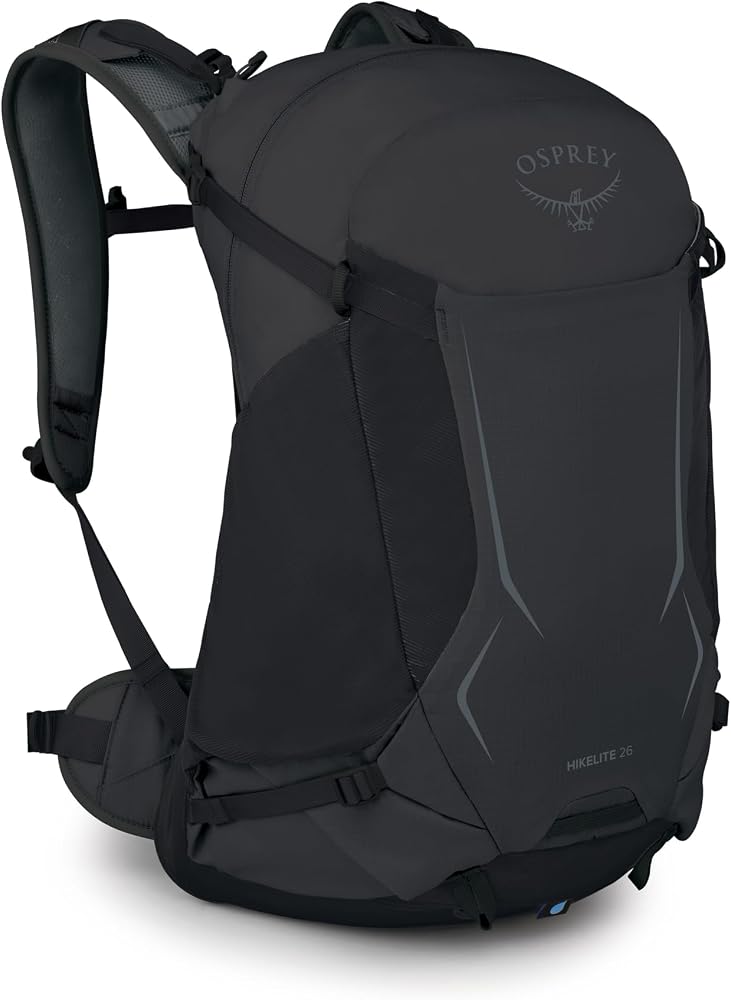
Best Overall: Osprey Hikelite 26L Hiking Backpack, Black OS
When someone walks into the shop and says "I hike three to eight miles on weekends and I want one pack," I hand them a 26-liter, and I hand them an Osprey first. That isn't brand loyalty talking. It's the warranty, the consistent sizing, and the fact that Osprey publishes a torso range instead of a list of 25 features and no fit information. A spec sheet that won't tell you who the pack is built for is a spec sheet that's hiding something.
Twenty-six liters is the sweet spot for a full day out. A shell, a puffy, lunch, two liters of water, a first aid kit, and a camera, with room left over for the layer you shed at the first switchback. It is a daypack, not a backpacking pack. If your plans include a sleeping bag, skip ahead to the 40L options.
What matters more than any of that is the frame sheet and the hip belt. Even at daypack sizes, a pack that puts its weight on your shoulders for six hours will wreck you by the car. On a 26L, the hip belt is a stabilizer rather than a full load transfer system, and that's exactly what it should be. You want it to hug your iliac crest and stay there, not ride up onto your waist every time you lean forward.
One thing to check before you commit: the name lists a single size. That means the torso range is the whole game. Measure from C7, the bony bump at the base of your neck, down to the top of your hip bones, and compare that number against the listed range. If it lines up, this is the pack I'd put on most people.
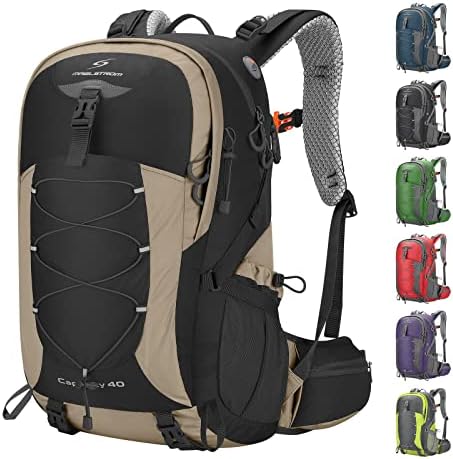
Best Value: MOUNTAINTOP 40L Hiking Backpack
Forty liters is the number I'd circle for a first overnight or a two-night weekend. It's enough for a light sleep system, a stove, food, and a layer, and it's small enough that you can't talk yourself into carrying a bowling ball. The MOUNTAINTOP is the budget entry into that size, and it's a legitimate one.
Here's the honest version of a budget pack. The money went somewhere, and it didn't go into the frame or the hip belt. That's not a knock, it's a trade. If you're buying at this price, you're accepting that the suspension won't transfer load the way a pack at four times the cost will, and you're compensating by keeping your base weight down and your expectations calibrated.
Which means the fit work is on you. Measure your torso first, load the pack the way you'd actually load it for a trip, and walk around the block before you commit to a trailhead. A 40L that sits low and loose will punish your shoulders in the first mile. A 40L that sits right will feel like nothing at all, and you'll wonder why anyone spends more.
This is also the pack I'd point a newer hiker toward over anything with a long feature list. You learn more about your own carry preferences in one season with a value pack than you do reading about suspension systems for a year. If you decide later that you want the premium version, you'll know exactly why you're paying for it.
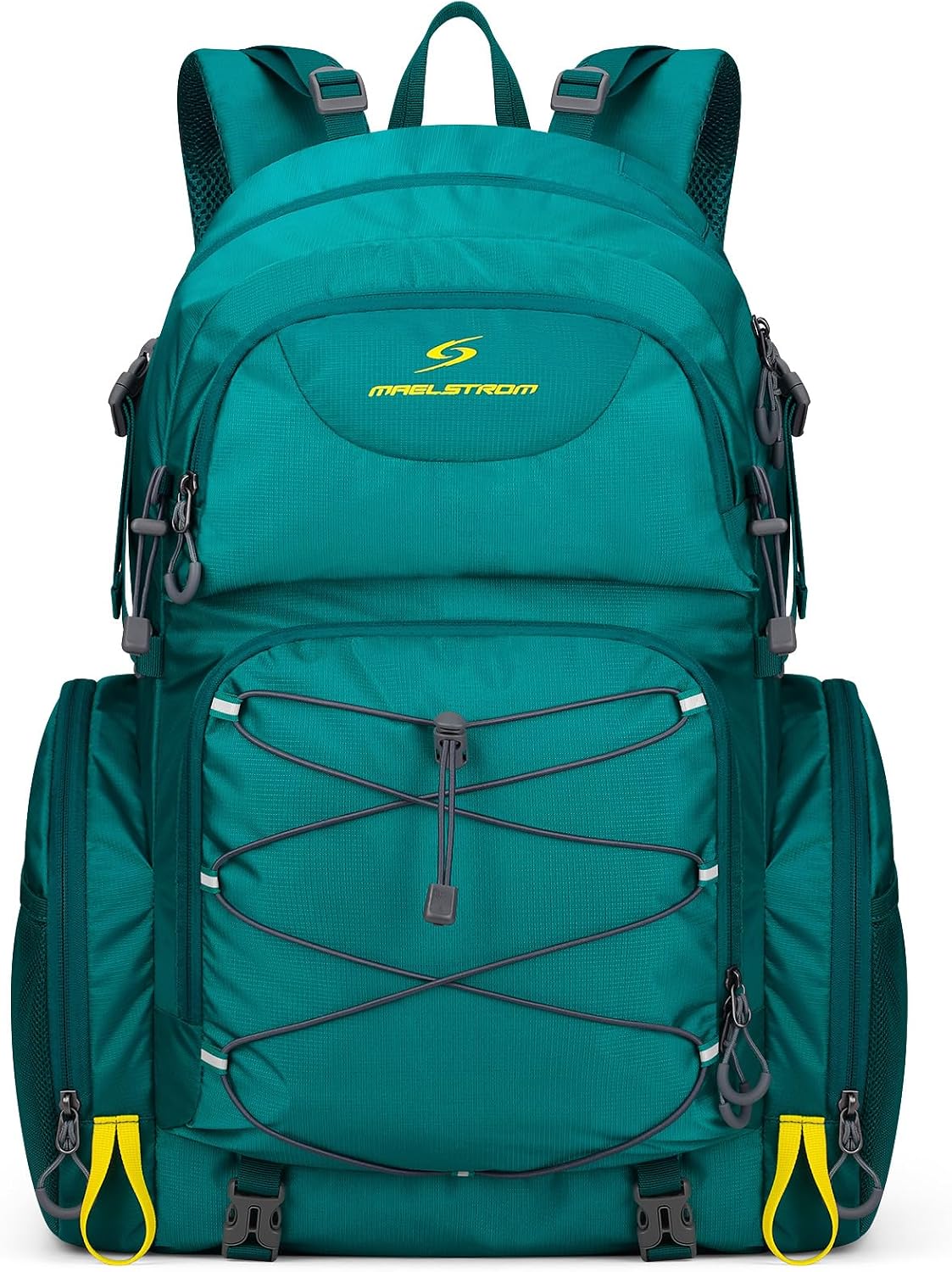
Best Wet-Weather Option: Maelstrom 40L Waterproof Hiking Backpack
I live in Seattle. I have opinions about rain gear that most people don't want to hear. So when a pack is described as waterproof at the same capacity as the budget pick above, that's worth talking about.
Waterproof fabric is a real advantage in the Pacific Northwest and on any coastal or boat-based trip. The catch is that waterproof fabric is not the same as a waterproof pack. Seams and zippers are still seams and zippers. If you're carrying a down bag or electronics, put them in a dry bag inside the pack regardless. Treat a waterproof shell as your first line of defense, not your only one. That's the same advice I give about rain covers, which have a habit of fitting the pack perfectly and not fitting the pack once it's actually loaded.
At 40 liters, this one covers the same trip range as the MOUNTAINTOP, and the choice between them comes down to conditions. If you hike in a wet climate, in shoulder seasons, or anywhere near water, the waterproofing is the feature you'll notice. If you hike dry and dusty, spend the money on fit instead.
The other thing I'd flag: a pack described as lightweight and travel-friendly at 40 liters is often a pack that expects a lighter load. Pack it the way you actually hike and see where the weight lands. If it's on your hips, you're good. If it's on your shoulders by mile three, you've overloaded it.
Best Packable Daypack: 15L Small Hiking Backpack Travel Daypack
A 15-liter packable is not the pack you hike with. It's the pack you keep inside the pack you hike with. It folds down small enough to disappear into a duffel or a suitcase, and it's the difference between doing a summit side trip and skipping it because your 40L is too much to carry up a rock scramble.
The trade for that packability is structure. A pack that folds into its own pocket doesn't have a frame sheet worth the name, so it will not carry weight well. Keep it under about ten pounds. Water, a shell, snacks, a phone, a map. That's the load. If you try to make it your overnight pack, you'll be miserable by mile two, and it won't be the pack's fault.
Where it earns its place is travel. A 15L under the seat, then unfolded at the destination for day hikes. That's a genuinely useful piece of gear, and at this size and price it's the kind of thing you buy two of and leave one in the car.
How I test hiking backpacks
Every pack gets the same treatment, and none of it happens in a living room. Torso measurement first, always. Then a loaded 10-mile hike with the pack packed the way it would be packed for a real trip, not a photo shoot. Then a hip belt transfer check, which is the only test that matters: at mile eight, is the weight on my hips or on my shoulders? Then a 30-day daily carry trial, because a pack that's great on a Saturday can still be a pack that annoys you by the third week.
I keep a grams-per-mile logbook. I weigh everything, including the things I'm sure I already know the weight of.
The specific things I'm watching for are boring and consistent. Does the hip belt ride up onto my waist when I lean forward on a climb? Can I reach the pockets I need while I'm walking, or do I have to stop and take the pack off? Does the rain cover still fit once the pack is loaded, or does it fit the empty pack and nothing else? Is the sternum strap in a place where it does something, or is it decoration?
A pack is only as good as its worst pocket. A useless pocket is worse than no pocket, because you'll fill it and then resent it for six miles.
What the sizes actually mean
Liters are volume, not capability. A 15L, a 26L, and a 40L are not three points on the same line. They're three different tools, and the failure mode is almost always buying one size up "just in case." Extra volume invites extra weight, and extra weight is what breaks a carry that would otherwise have been fine.
The hip belt does about 80% of the work. Everything else, the pockets, the compression straps, the daisy chains, is organization layered on top of that one fact. On a 15L packable there's essentially no hip belt and no frame, so your shoulders carry everything, which is fine at ten pounds and miserable at thirty. On a 26L, the hip belt stabilizes. On a 40L, it should genuinely transfer load, and if it doesn't, the pack is the wrong pack for you regardless of the brand.
Torso length is the spec everyone ignores and the one that matters most. It's the measurement from C7 to your iliac crest. Get it wrong and no pack fits, at any price. This is also why I'd rather see someone buy a cheap pack in the right torso size than an expensive one in the wrong size. You cannot fix a bad fit with money.
And yes, I'll say the unpopular thing: nobody needs a $600 pack for weekend hikes. The premium packs earn their price on long carries with heavy loads. If your trips are day hikes and the occasional overnight, the value end of this list will serve you for years.
Hiking backpack size comparison table
| Pack | Capacity | Best for | What to check | Verdict |
|---|---|---|---|---|
 Visit on Amazon → Visit on Amazon →Osprey Hikelite 26L |
26L | Day hikes, 3 to 8 miles | Torso range, since the name lists one size | Best overall daypack |
 Visit on Amazon → Visit on Amazon →MOUNTAINTOP 40L |
40L | First overnights, weekend trips | Where the load sits at mile eight | Best value |
 Visit on Amazon → Visit on Amazon →Maelstrom 40L Waterproof |
40L | Wet climates, coastal and boat trips | That critical gear still goes in a dry bag | Best wet-weather option |
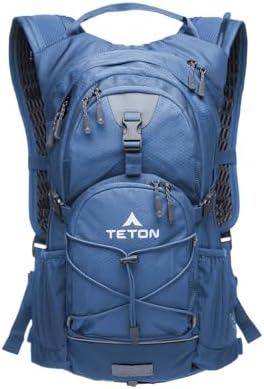 Visit on Amazon → Visit on Amazon →15L Small Hiking Backpack |
15L | Travel, summit days, a spare in the car | Keeping the load under ten pounds | Best packable |
Should you buy the Osprey Hikelite 26L?
Yes, if the torso range lines up with your measurement. It's the daypack I recommend first because Osprey publishes a fit range instead of a feature list, the sizing is consistent across the line, and the warranty is the best in the business. Twenty-six liters covers a full day out comfortably. If your trips involve a sleeping bag, size up to a 40L instead and don't try to make a daypack do an overnight's job.
Should you buy the MOUNTAINTOP 40L?
Yes, if you're on a budget and you're willing to do the fit work yourself. Forty liters is the right capacity for a first overnight, and the price is the entire reason to look at it. The frame and hip belt are where the money was saved, so measure your torso before you buy, load it the way you'd load it for a trip, and don't expect a premium carry. Keep your base weight down and it'll do the job.
Should you buy the Maelstrom 40L Waterproof?
Yes, if you hike wet. Waterproof fabric is a genuine upgrade in the Pacific Northwest and on any trip near water, and 40 liters keeps the same trip range as the budget pick. Just remember that waterproof fabric isn't a waterproof pack. Seams and zippers still let water in, so dry bags for the sleeping bag and the electronics, every time.
Should you buy the 15L Small Hiking Backpack?
Yes, as a second pack, not a first one. It folds small, disappears into a duffel, and turns a travel day into a hiking day. Keep the load light, because there's no frame and no real hip belt, and treat it as a summit pack and a travel pack. For that job, at that size, it's an easy yes.