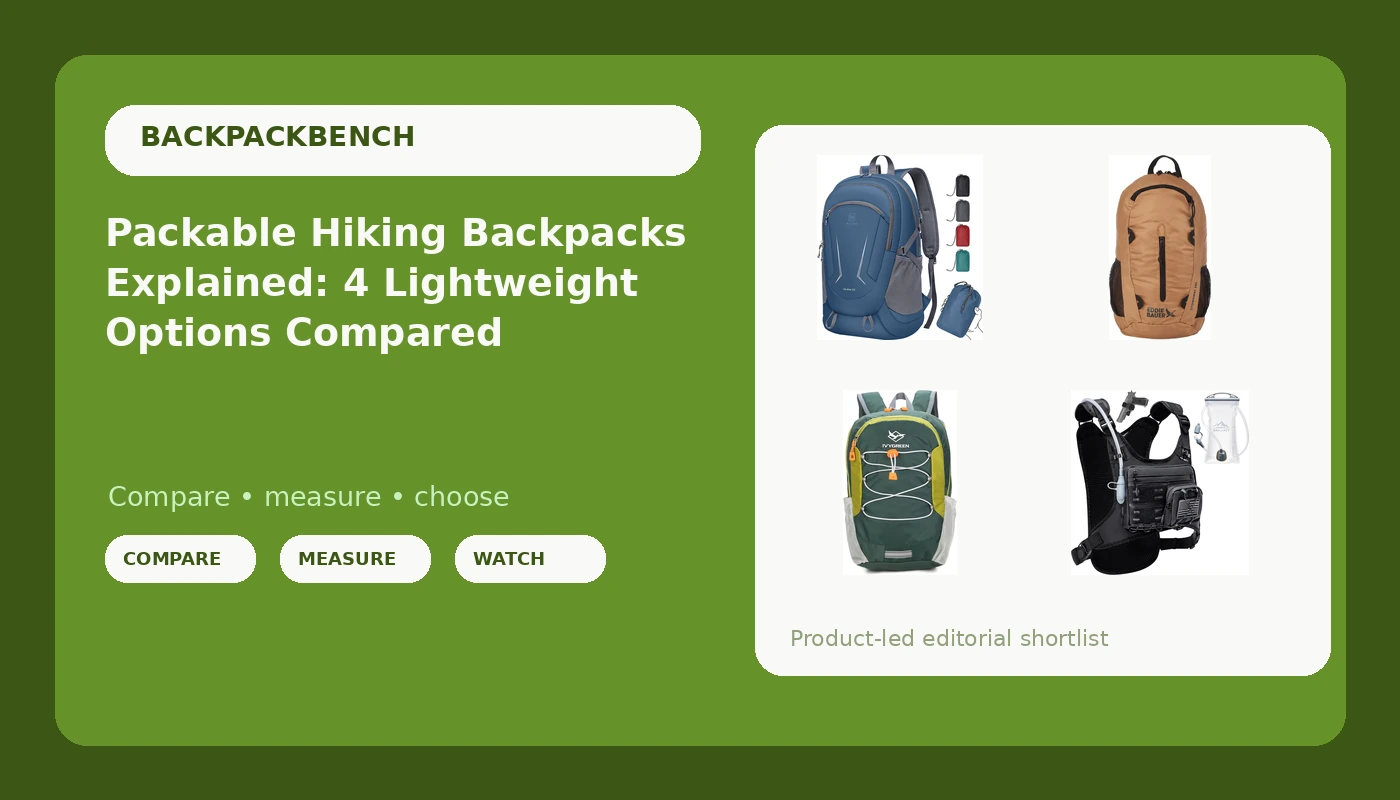
Packable hiking backpacks solve a problem that framed packs create: commitment. A packable bag folds down small, rides along in a suitcase or inside a bigger pack, and turns a spur-of-the-moment trailhead stop into an actual hike. The trade is real, though. Packable hiking backpacks skip the frame, the padded hip belt, and usually the torso adjustability that make a loaded pack comfortable at mile eight. What you get in return is low weight, a small packed size, and a price that does not require a season of research.
That trade is exactly where most buyers get stuck. A pack that carries beautifully at 20 pounds and a pack that disappears into a luggage compartment are built differently, and the marketing copy rarely says which one you are looking at. The four options below cover four different jobs: a hydration vest for running and fast movement, a 35L daypack, a 20L stowaway, and a kids pack sized for a smaller frame. None of them is a substitute for a framed overnight pack, and pretending otherwise is how people end up miserable on day two.
Related: Packable Backpack vs Daypack: What Actually Changes on Trail →
Quick answer
Match the pack to the trip and to the body carrying it. A 35L packable daypack covers a full day out with layers and food, a 20L stowaway suits short hikes and travel, a hydration vest is built for running and light fast movement, and a kids pack is sized for a child. Capacity, carry style, and intended user matter more here than any feature list.
Four useful options
| Model | Best fit | What stands out |
|---|---|---|
| Zelvot Running Vest with 2L Water Bladder | Running, fast day hikes, chest carry | Includes a 2L bladder and a gear holder, with reflective detailing |
| MIYCOO Ultralight Packable Backpack, 35L | Full-day hikes with layers and food | Largest capacity here, described as packable and waterproof |
| Eddie Bauer Stowaway Packable Backpack, 20L | Short hikes, travel, backup bag | Mid-size packable option from an established outdoor brand |
| IVYGREEN Small Kids Hiking Backpack, Green, M | Children on camping trips and short walks | Sized for kids, with a medium fit in a green colorway |
The hydration-first option: Zelvot Running Vest with 2L Water Bladder
A vest carries weight on the front of the torso and across the shoulders, which is a genuinely different feeling from a backpack. For running and fast hiking that is an advantage: the load sits close, does not sway, and water is reachable without stopping. The trade-off is volume. A vest holds water, a phone, a snack, and a light layer, not a full day of gear, and it is not designed to transfer load to your hips the way a framed pack does. If your trip involves a shelter, a stove, or a change of clothes, this is the wrong category.
The full-day option: MIYCOO Ultralight Packable Backpack, 35L
Thirty-five liters is the volume where a daypack starts feeling like real capacity rather than a stuff sack with straps. That is enough for a shell, a puffy, lunch, two liters of water, and a first aid kit on a long day hike. The honest trade-off is that packability and structure pull against each other. A bag that folds into its own pocket usually has a soft back panel and a webbing belt rather than a load-bearing frame, so the weight rides on your shoulders. Keep the load under roughly fifteen pounds and that is fine. Push past it and you will feel every ounce by the end of the day.
The travel-friendly option: Eddie Bauer Stowaway Packable Backpack, 20L
Twenty liters is the sweet spot for the bag you keep folded in a suitcase or at the bottom of a larger pack. It handles a water bottle, a layer, a camera, and snacks without turning into a project. What it will not do is carry a full day of hiking gear comfortably, and that is not a flaw, it is the point of the category. If you are choosing between this and the 35L option, the question is not which is better but how much you actually carry on a typical outing. Most people overestimate that number.
The kids option: IVYGREEN Small Kids Hiking Backpack, Green, M
Kids quit hiking over uncomfortable packs more often than over distance. An adult pack on a child's frame puts the load in the wrong place, and children have shorter torsos and narrower shoulders, so the straps never sit where they should. A pack built for kids is not a luxury, it is the difference between a child carrying their own water bottle and you carrying everything. Keep the load genuinely light, a snack, a water bottle, and a small layer, and let the pack be theirs. Ownership matters more than capacity at that age.
Prices and availability may change. Product images, names, and retailer links are matched to verified listings. No current price, rating, stock status, or measured result is stated here without current evidence.
Why packable packs carry differently
The single biggest misunderstanding about this category is that packability is a carrying feature. It is not. It is a storage feature, and it usually comes at the direct expense of the things that make a load comfortable.
Load transfer is the first casualty. On a framed pack, a hip belt wraps the iliac crest and the frame pushes weight down into it, so the shoulders carry a fraction of the total. Most packable daypacks have a webbing strap or a lightly padded belt instead. That belt can stabilize the pack, but it cannot transfer meaningful load, because there is no frame to bridge the gap between your shoulders and your hips. The weight stays high and forward. On a light load that is barely noticeable. On a heavy one it is the whole day.
Torso length is the second issue. The measurement from the C7 vertebra at the base of your neck down to the top of your hip bones determines where a pack's shoulder straps should sit. Framed packs come in torso ranges so you can match that number. Packable packs usually come in one size and rely on strap adjustment to cover everyone. That works fine when the pack is light and the straps are just holding fabric against your back. It stops working when the pack is heavy enough to need a real fit.
Finally, packable fabrics tend to be thinner, because thin fabric packs smaller. That is a reasonable trade for a backup bag and a poor one for a pack you scrape against granite every weekend. Neither approach is wrong. They are just answering different questions.
Matching capacity, carry style, and body size
Capacity in liters tells you volume, not comfort. A 35L pack and a 20L pack can weigh the same empty, but the 35L invites you to fill it, and the filled weight is what you actually carry. The useful move is to estimate your real load first, then pick the smallest pack that holds it.
Carry style is the second filter. A backpack puts weight on your shoulders and back. A vest puts it on your chest and shoulders. A hip belt pack puts most of it on your hips. Each one shines in a different activity, and choosing the wrong one for your sport is more consequential than any pocket layout.
Body size is the third, and it is the one people skip. A child needs a child's pack. A shorter adult may find a small pack's strap geometry works better than a unisex one. Here is a simple sequence:
- Write down everything you actually carry on a typical outing, including water.
- Estimate that load's weight and volume, and add a small margin for weather layers.
- Choose the carry style that matches your activity: vest for running, daypack for hiking, stowaway for travel.
- Check the pack's intended user and sizing against the person who will wear it.
- Confirm the listing details you care about, such as bladder inclusion or waterproof construction, before you buy.
What to check before you buy
- Confirm whether a hydration bladder is included, since a vest listing that mentions a 2L bladder is a different purchase than a bare harness.
- Read the waterproof claim carefully. Waterproof construction and water-resistant fabric are not the same thing, and closures matter as much as material.
- Check the packed size, not just the capacity, if the bag's job is to live inside luggage.
- Match the pack to the wearer's size. A medium kids pack is sized for a child, not for an adult who wants a small bag.
- Decide what happens at mile eight with your expected load, and be honest about whether shoulder carry is acceptable for that distance.
Which option should you choose?
Choose the Zelvot Running Vest with 2L Water Bladder when your priority is water and a few essentials carried close to your chest for running or fast, light movement. Choose the MIYCOO Ultralight Packable Backpack, 35L when you need the most capacity here for a full day of hiking with layers and food. Choose the Eddie Bauer Stowaway Packable Backpack, 20L when you want a light packable bag for short hikes, travel, or backup duty. Choose the IVYGREEN Small Kids Hiking Backpack, Green, M when the person carrying the pack is a child heading out on a camping trip or a short walk.
One caveat applies to all four. The details above come from the product listings themselves, including stated capacities, included items, and construction claims. They are not measurements taken here, and packability, comfort, and fit vary with the load and the person. Treat the listed specs as a starting point and confirm anything that decides your purchase on the current listing.
The bottom line
These four packs are not competing for the same job, which is why comparing them on features alone leads nowhere. A hydration vest, a 35L daypack, a 20L stowaway, and a kids pack each answer a different question about how much you carry, how you carry it, and who is wearing it. Get the category right first, then the capacity, then the size, and the feature list becomes a detail rather than a decision. Pick the pack that matches your actual trips, keep the load light enough for shoulder carry, and none of these will let you down.