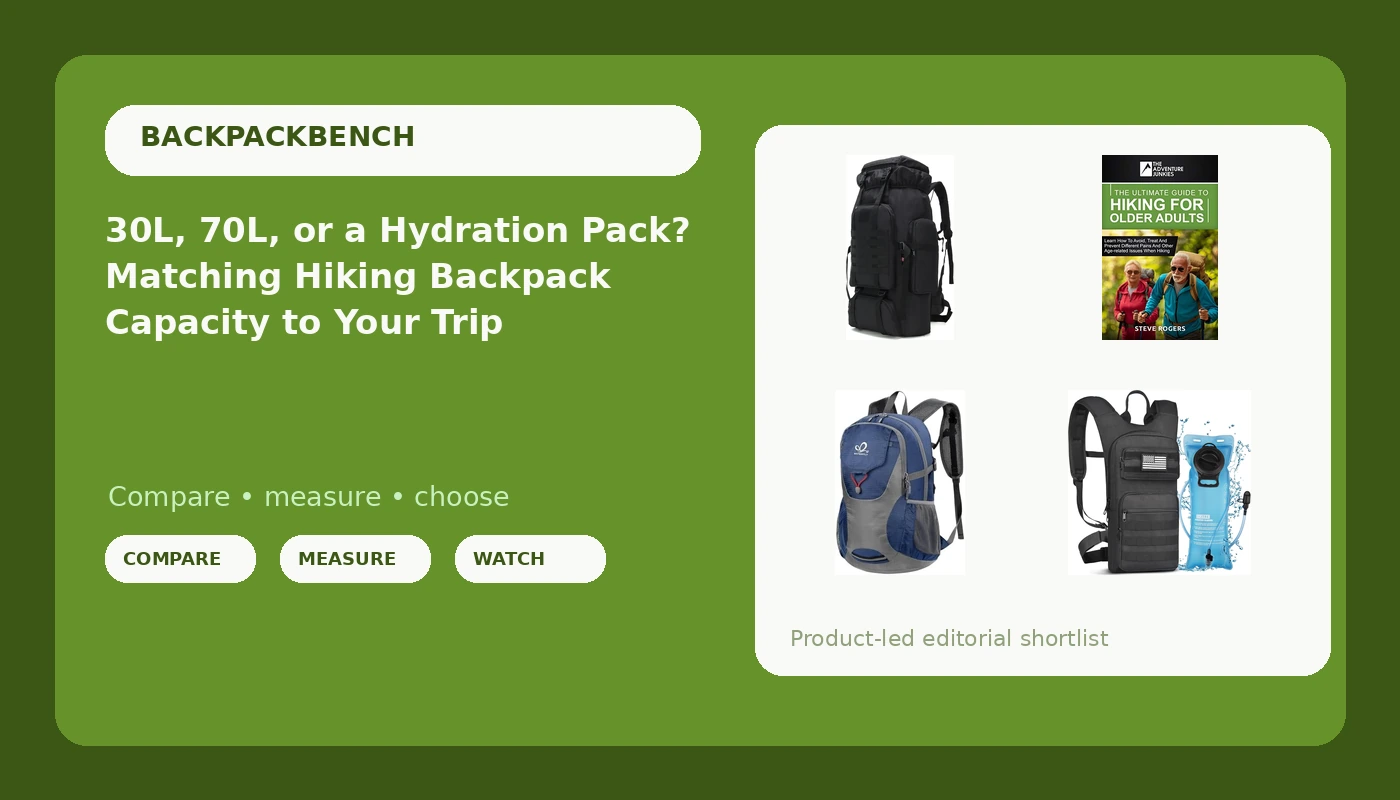
Hiking backpack capacity is the decision most people make backwards. They buy the bag that looked right on the shelf, then find out at mile four that a 70L rucksack was overkill for an afternoon loop, or that a 30L day pack was never going to swallow an overnight load. The number on the label is not a quality score. It is a volume, and volume only means something next to the trip you are actually taking. This explainer looks at four very different items that cover most of that range: a packable 30L day pack, a hydration pack with a 3L bladder, a 70L/100L rucksack, and a book about hiking later in life. Between them, they answer the question people ask me most often at the shop, which is not "which pack is best" but "which pack is right for the hike I keep doing."
Related: How to Measure Your Torso Length Before You Buy a Hiking Backpack →
Quick answer
Capacity should be chosen after trip length, and fit should be chosen before both. A pack in the 30L range covers most single-day hikes with layers, food, and water. A hydration pack with an included bladder suits fast, light outings where drinking on the move matters more than hauling gear. A 70L or 100L rucksack is for multi-day loads where shelter, food, and several days of water carry live in the bag. None of those volumes means anything if the torso length is wrong, because an ill-fitting pack puts the load on your shoulders instead of your hips.
Four useful options
| Model | Best fit | What stands out |
|---|---|---|
| WATERFLY Lightweight Packable Hiking Backpack, 30L Day Pack Blue | Single-day hikes and travel | 30L volume in a lightweight, packable design |
| NOOLA Hydration Backpack with 3L Water Bladder, Tactical Pack for Hiking | Moving fast with hands free | Ships with a 3L water bladder |
| Hiking Backpack for Men 70L/100L Camping Backpack Military Rucksack Molle 3 Days Assault Pack for Climbing | Multi-day and heavy loads | 70L/100L volume with MOLLE webbing |
| The Ultimate Guide To Hiking For Older Adults | Planning, pain management, and recovery | Focused on preventing and treating hiking-related pain |
The day pack: WATERFLY Lightweight Packable Hiking Backpack, 30L Day Pack Blue
Thirty liters is the sweet spot I recommend to anyone who hikes mostly day trips and wants one bag that also travels. It holds a rain shell, a puffy, lunch, two liters of water, and a first aid kit without turning into a duffel with straps. The trade-off is the ceiling: the moment you add a sleeping bag and a tent, you are out of room, and no amount of strapping things to the outside fixes a load that has outgrown its bag. Packable construction also means the fabric is chosen for low weight, so treat a pack in this class as a day pack and not as something you drag through granite scree for a month. If your hikes are loops, summits, and travel days, this is the size to start with.
The hydration pack: NOOLA Hydration Backpack with 3L Water Bladder, Tactical Pack for Hiking
A bladder changes how you drink. With bottles, most people stop, unclip, sip, and lose five minutes; with a hose, they sip while walking and finish the day better hydrated. The included 3L bladder here is the reason to consider this pack, because buying a reservoir separately is one more compatibility question you have to solve. Three liters is a real day of water in mild conditions and a partial day in serious heat, so plan refills on exposed routes. The tactical layout adds organization and attachment points, which is a benefit if you carry tools or a camera and a drawback if you want the lightest possible bag, since every strap and panel is weight you feel on a long climb.
The multi-day hauler: Hiking Backpack for Men 70L/100L Camping Backpack Military Rucksack Molle 3 Days Assault Pack for Climbing
This is the category where fit stops being a preference and becomes a requirement. A 70L load with food and water in it can run well past 30 pounds, and at that weight the hip belt does the carrying. If the belt rides up onto your waist instead of sitting on the crest of your hips, your shoulders take the whole load and mile eight tells you about it. The MOLLE panel is genuinely useful for strapping on a sleeping pad or a wet layer, but it also invites overpacking, and volume you fill is volume you carry uphill. The 70L option suits three-day trips with light gear; the 100L option is for winter loads, group gear, or long resupply gaps where bulk is unavoidable.
Prices and availability may change. Product images, names, and retailer links are matched to verified listings. No current price, rating, stock status, or measured result is stated here without current evidence.
The companion read: The Ultimate Guide To Hiking For Older Adults
Gear solves load, not knees. This is the one item in the list that is not a bag, and I include it because the hikers who ask me the hardest questions are the ones who started late, or restarted after twenty years, and their problems are not solved by spending more on a pack. Aching hips, sore feet, and recovery that takes longer than it used to are fit and pacing issues as much as equipment issues. A book like this belongs next to your pack on the shelf, and it pairs well with a properly fitted bag: the pack takes weight off your shoulders, and the reading takes some of the guesswork out of how much you should be carrying at all.
How capacity maps to trip length
Capacity is a proxy for how many days you can be self-sufficient, and the mapping is rougher than the labels suggest. A 30L pack is a day pack: layers, food, water, emergency kit. Around 50L you can usually manage an overnight with compact gear, depending on how bulky your sleeping bag is. At 70L you are into multi-day territory with a tent, a bag, a pad, and food. At 100L you are carrying bulk on purpose, which usually means winter conditions, group gear, or a long stretch between resupplies.
The mistake is buying for the biggest trip you might take. A pack sized for a trip you do once a year is a pack you carry empty, awkwardly, on the twenty weekends when you only needed thirty liters. It is also worth remembering that capacity numbers are not standardized across brands, so two packs labeled 40L can hold noticeably different loads once the shape, pocket layout, and lid are accounted for. Judge a pack by what fits inside it in the configuration you actually pack, not by the number printed on the side.
Fit comes before features
Every feature on a pack is worthless if the torso length is wrong. Torso length is measured from the bony bump at the base of your neck down to the top of your hip bones, and it is not your height. Two people the same height can need different pack sizes. That is why the fit conversation starts with a tape measure, not with a spec sheet listing twenty-five features and no torso range.
- Measure your torso length from the base of the neck to the top of the hips, and write the number down.
- Match that number to the pack's torso range before you look at volume, color, or price.
- Decide the longest trip you realistically take this season, then choose capacity for that trip, not for a fantasy trip.
- Load the pack with the weight you expect to carry and check where it sits. The hip belt should carry the load, with the shoulder straps doing balance rather than lifting.
- Walk a mile with it before you commit. Packs feel different loaded and moving than they do on a shop floor.
Practical guidance
- Buy capacity for the trips you take most often, not the trip you take once.
- Treat a hydration bladder as a hydration decision, not a pack decision, and check that any reservoir you add fits the sleeve.
- Keep the load close to your back. A pack that sits far off your spine pulls you backward all day.
- Weigh your gear at home. Base weight, which is everything except food, water, and fuel, is the number that decides which capacity you need.
- Recheck the fit when the load changes. A pack that carries well at 15 pounds may need a tighter hip belt at 35.
Which option should you choose?
Choose the WATERFLY Lightweight Packable Hiking Backpack, 30L Day Pack Blue when your hiking is day trips, travel, and light loads, and you want one pack that folds away when it is not in use. Choose the NOOLA Hydration Backpack with 3L Water Bladder, Tactical Pack for Hiking when drinking on the move matters and you would rather buy the bladder and the pack in one purchase. Choose the Hiking Backpack for Men 70L/100L Camping Backpack Military Rucksack Molle 3 Days Assault Pack for Climbing when you are carrying shelter, food, and multiple days of supplies and need real volume with attachment points for extra gear. Choose The Ultimate Guide To Hiking For Older Adults when the limit on your hiking is not pack space but pain, recovery, and the changes that come with age.
One caveat before you buy any of them: none of these listings can tell you whether a pack fits your torso. Volume and features are visible online; fit is not. If you are between sizes or new to multi-day hiking, get measured first and treat the capacity chart as the second question you answer, not the first.
The bottom line
Hiking backpack capacity is a trip-length decision, and fit is a body decision, and the two of them together decide whether a pack works for you. A 30L day pack covers the majority of hikes most people actually do. A hydration pack with a 3L bladder solves the drinking problem for fast, light days. A 70L or 100L rucksack is the tool for multi-day loads where the hip belt, not the shoulder straps, has to carry the weight. And a book about hiking as you get older is a reminder that not every trail problem is a gear problem. Start with torso length, then capacity, then features, and you will end up with a pack you stop thinking about by mile three.