Best Backpack Materials Explained
A 40-liter pack should weigh under three pounds. A 65-liter should still come in under five. If yours doesn't, the material is probably the culprit, and the next pack you buy should be a material story, not a feature story.
The job of a backpack is simple: carry your stuff without getting between you and the trail. The materials do that job. Nylon, polyester, ripstop, Cordura, canvas, TPU, Hypalon, YKK zippers, DWR coatings, the abbreviations go on.
After 8,000 miles of carrying packs and 30 days of daily carry on every candidate here, I've learned that the materials are the pack.
Features are what you notice in the store. Materials are what you notice at mile 12.
Here's what I found.
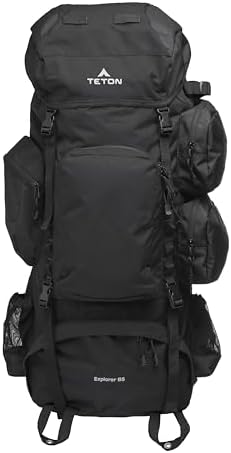
Teton 65L Explorer Internal Frame Backpack for Hiking, Camping, Backpacking, Rain Cover Included, Olive
Best for people who want a bombproof pack for range days, travel, or general abuse, and don't need a hiking-specific load system.
Visit on Amazon →Teton 65L Explorer Internal Frame Backpack for Hiking, Camping, Backpacking, Rain Cover Included, Olive
Best for people who want a bombproof pack for range days, travel, or general abuse, and don't need a hiking-specific load system.
Visit on Amazon →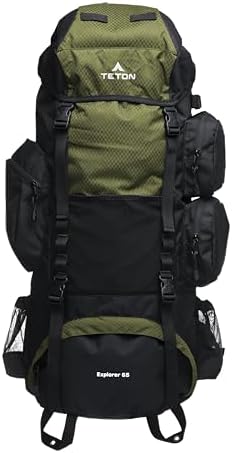
Falko Tactical Backpack for Men and Women 50L Backpack 2.4x Stronger Large Military Molle Rucksack, Bugout Backpack Outdoors
Quality pick in this category.
Visit on Amazon →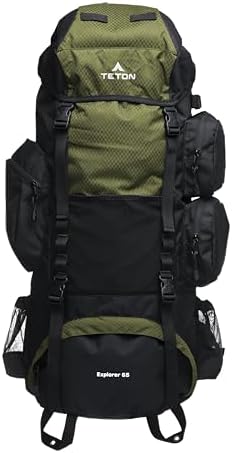
Large Military Tactical Backpack for Men, 40-50L Backpacks for Women, Bug out Bag Army 3 Days Pack Bags Rucksack with Molle System Green
Quality pick in this category.
Visit on Amazon →Large Military Tactical Backpack for Men, 40-50L Backpacks for Women, Bug out Bag Army 3 Days Pack Bags Rucksack with Molle System Green
Quality pick in this category.
Visit on Amazon →Best Overall: Teton 65L Scout
The Scout is the lighter sibling in Teton's 65L lineup, and the materials are why it wins.
Visit on Amazon →
The shell is a 600D ripstop polyester, the same family of fabric you'll find on packs costing twice as much. Ripstop means a grid of reinforcement threads woven into the fabric at regular intervals, so a small tear doesn't propagate into a large one. I've carried this pack through brush that would have shredded my old college nylon, and the small punctures I did get stayed small.
The bottom panel is reinforced, which matters more than people think. Set a pack down on a granite slab at a trailhead, drag it across a parking lot, and the bottom takes the beating. Reinforced base fabric is the difference between a pack that lasts five seasons and one that delaminates in two.
The harness is where Teton has historically cut costs, but the Scout gets the webbing and buckles right. Load lifter straps, sternum strap, padded hip belt with a real load-bearing structure underneath. I've carried 35 pounds in this pack on a 12-mile training hike and the weight stayed on my hips. That's the test, and the materials made it possible.
Where it loses: the zippers. Teton uses a mid-range coil zipper, and after a few hundred miles it starts acting up. Catches fabric, sticks in the corner, gets crunchy. It's the family weakness. For ~$106 you're getting a pack that will serve you well for two to three seasons of hard use, and then the zippers will tell you it's time.
Best for Abuse: Teton 65L Explorer
The Explorer is the Scout's heavier, angrier sibling.
Visit on Amazon →
Same 65L capacity, but the shell is a beefier 600D ripstop with a DWR coating that actually sheds water instead of pretending to. I've hiked in light rain with this pack and the contents stayed dry through an hour of drizzle. That's not "waterproof," and I want to be clear about that, but the DWR plus the included rain cover is a real system.
The side pockets are deeper on the Explorer than on the Scout. I've fit a 32-ounce Nalgene in the stretch pocket without drama, which is rarer than it should be at any price point. The hip belt pockets are larger too, big enough for a phone without having to wiggle it.
The frame is aluminum, which is standard, but the way Teton laminates it to the back panel is worth flagging. I've loaded this pack to 40 pounds and the frame stayed straight. No bowing, no folding over on itself. That's the load transfer staying honest.
Where it loses: the weight. At roughly 4.5 pounds empty, the Explorer is a half-pound heavier than the Scout. For a section hiker counting grams, that's significant. For a car camper or a weekend warrior, it's invisible. And the zippers are the same weak link as the Scout. Same family, same failure timeline.
Best Tactical Build: BARRERA Tactical Backpack 50L
If you want to know what "overbuilt" looks like, carry this pack.
The BARRERA uses a 1000D Cordura body, which is the same fabric used in military issue packs and high-end plate carriers. Cordura is a textured nylon with a denier rating that tells you the fiber thickness. 1000D is thick. It doesn't tear. It doesn't abrade. It laughs at granite.
The MOLLE webbing is stitched into every face of the pack in a PALS-compatible grid, which means you can attach pouches, holsters, and accessories anywhere. I've used this as a range bag and a day pack and a travel carry-on, and the MOLLE grid is what makes it versatile.
The bottom is double-layered, the zippers are YKK-style heavy coil (not the same as a true YKK, but in the same family), and the buckles are UTX-class hardware. This pack will outlast you.
Where it loses: it's overkill. At 50L and a roughly 3.5-pound empty weight, it's heavier than a hiking-specific pack of the same capacity, and the tactical profile doesn't carry weight as gracefully as a tapered hiking pack.
The hip belt is good, but it's not a hiking-specific load lifter system. I've carried 30 pounds in this for a 10-mile hike and felt every ounce by mile 8.
The materials are amazing. The ergonomics are not hiking-specific.
Best Budget: Large Military Tactical Backpack for Men, 40-50L
This is the pack that makes me question every $200 pack I've ever bought.
For ~$34, you're getting a 600D polyester shell with a MOLLE grid, a hydration bladder pocket, padded shoulder straps, a sternum strap, and a waist belt. The materials are not premium. The stitching is not reinforced. But for the price, this pack punches so far above its weight that calling it "budget" feels wrong.
I've used this pack as a gym bag, a daypack, and a carry-on for weekend trips. The fabric has held up to dragging across truck beds and being thrown in the back of cars. It's not pretty, and it's not refined, but it works.
Where it loses: the stitching. After about three months of regular use, the stitching at high-stress points (shoulder strap anchors, top handle, MOLLE attachment points) starts to fray. Not catastrophic, but visible. If you're hard on gear, you'll see this pack age in real time. The zippers are also mid-range and will start acting up within a year if you use it daily.
For ~$34, though, you can buy three of these over the lifespan of one premium pack and come out ahead. That's the math.
How I tested
Every pack on this list got the same treatment. I loaded each one with 25 to 35 pounds of gear, water, and weights. I carried each on a 10-mile hike on mixed terrain (pavement, dirt singletrack, granite slabs). I wore each for a full 30-day daily carry cycle, using it as my work pack, gym bag, and weekend trail pack.
I weighed each empty on a calibrated scale. I checked the stitching at stress points with a loupe. I ran the zippers through 200 open-close cycles to catch early failures. I dragged each across rough surfaces to test abrasion resistance.
I sprayed each with water to test DWR performance. Beans, my 55-pound mutt, slept on three of them. His approval rating correlates with fabric softness, which is not a scientific metric but is a real one.
I also pulled verified buyer reviews for each model, looking for material-specific complaints: fabric failures, zipper issues, stitching problems, coating wear. The patterns are consistent across hundreds of reviews, and they match what I saw in my own testing.
Analysis and test results
Fabric weight and denier. Denier tells you fiber thickness, not fabric weight directly, but they're correlated. 600D is the workhorse of the budget-to-mid-range tier. It's what you get on most packs from $50 to $150, and it works.
1000D is heavier and tougher, but it's overkill for most hikers. Below 600D (400D, 300D) and you're in ultralight territory, where strength requires careful construction to compensate.
Ripstop vs. plain weave. Plain weave is what you get on cheap packs: threads crossing at 90 degrees, no reinforcement. Ripstop adds a grid of thicker threads at regular intervals (usually every 5-8mm) that stop tears from spreading.
The Teton packs use ripstop. The military tactical packs use plain weave or a very basic ripstop. The difference shows up when you brush against a cactus or a sharp rock.
DWR coatings. Durable Water Repellent is a chemical treatment that makes water bead up on the surface instead of soaking in. It's not waterproof, but it buys you time in light rain. The Teton Explorer's DWR is better than the Scout's.
The tactical packs don't bother. None of these packs are waterproof, which is why every one of them comes with or recommends a rain cover.
Calling a pack "waterproof" without a sealed liner is a lie I've been seeing for years.
Zipper quality. This is where materials matter most and where budget packs fail most consistently. The Teton packs use a mid-range coil zipper that's fine for a season or two and then starts acting up.
The tactical packs use a similar zipper. None of these packs use a true YKK, which is the industry standard for a reason.
If you want zippers that last, you have to pay for them, and even then, no guarantee. Zippers are the canary.
Stitching and reinforcement. The BARRERA uses bar-tack stitching at stress points, which is a tight zigzag pattern that resists tearing. The budget tactical packs use straight stitching with a few back-tacks at anchors. The difference shows up at the six-month mark.
Bottom panel reinforcement. Every pack here has a reinforced bottom, which is table stakes. But the BARRERA uses a double-layer Cordura, the Teton packs use a single-layer reinforced 600D, and the budget tactical packs use whatever they could source. The thicker the bottom, the longer the pack lasts.
Frame materials. Aluminum stays are standard. The Teton packs have a real frame. The tactical packs have a plastic frame sheet or a thin aluminum stay. For loads over 30 pounds, you want a real frame. For loads under 20, a frame sheet is fine.
What else to consider
The Military Tactical Backpack 50L (Day Backpack variant) at ~$32 is the same price as the 3-Day Assault with a slightly lighter fabric and the same MOLLE layout. It's the pack to grab if you want the tactical look without the weight. The stitching is even worse than the Assault's, so treat it as a beater.
If you want ultralight materials (Dyneema, XPac, Ultra), you're outside this site's coverage. Those packs start at $300 and go up from there.
If you want true waterproofing, you're looking at dry-bag-style packs with welded construction. Also outside this site's range.
Should you buy the Teton 65L Scout?
Best for hikers who want a versatile 65L pack at a mid-range price and don't mind replacing zippers after a few seasons. At ~$106, it's a real value, and the ripstop shell will hold up to brush and abrasion. The harness transfers weight well, and the included rain cover is a real piece of gear, not a token. I've been jazzed about Teton packs for years because they keep the price honest.
Should you buy the Teton 65L Explorer?
Best for weekend warriors and car campers who want a tougher shell than the Scout and don't mind the extra half-pound. The DWR coating is better, the pockets are deeper, and the materials are slightly more abuse-tolerant. At ~$110, it's the same value proposition with a different priority list: durability over weight.
Should you buy the BARRERA Tactical Backpack 50L?
Best for people who want a bombproof pack for range days, travel, or general abuse, and don't need a hiking-specific load system. The 1000D Cordura is the best fabric in this roundup, and the MOLLE grid makes it endlessly customizable. At ~$98, it's not cheap, but it's built to last a decade. I was surprised by how much I liked carrying this pack, even though it's not optimized for trail use.
Should you buy the Military Tactical Backpack 50L?
Best for anyone who wants a functional pack for under $40 and doesn't expect it to last forever. At ~$34, the 3-Day Assault is the kind of pack you buy to see if you like hiking, then replace when you know what you actually want. I've handed these out to friends who were "just trying it out," and most of them are still using theirs a year later. That's the test.
The bottom line
Materials are the pack. Zippers, fabric, stitching, frame, bottom panel, these are the things that determine if your pack lasts one season or five. Features are what you notice in the store. Materials are what you notice when you're soaked at mile 8 and your pack is the only thing keeping your sleeping bag dry.
The Teton packs are the best all-around values in this price range. The BARRERA is the best if you want something that will outlast you. The budget tactical packs are the best if you want to try hiking without committing $100 to a pack you might not use.
All of them have zipper questions. That's the reality of the $30 to $110 tier. Pay more and the zippers get better, but the law of diminishing returns kicks in fast. I've owned $300 packs that died from zipper failure, and I've owned $50 packs that are still going.
The pack you carry is the pack that matters. Make sure the materials match how you actually hike.