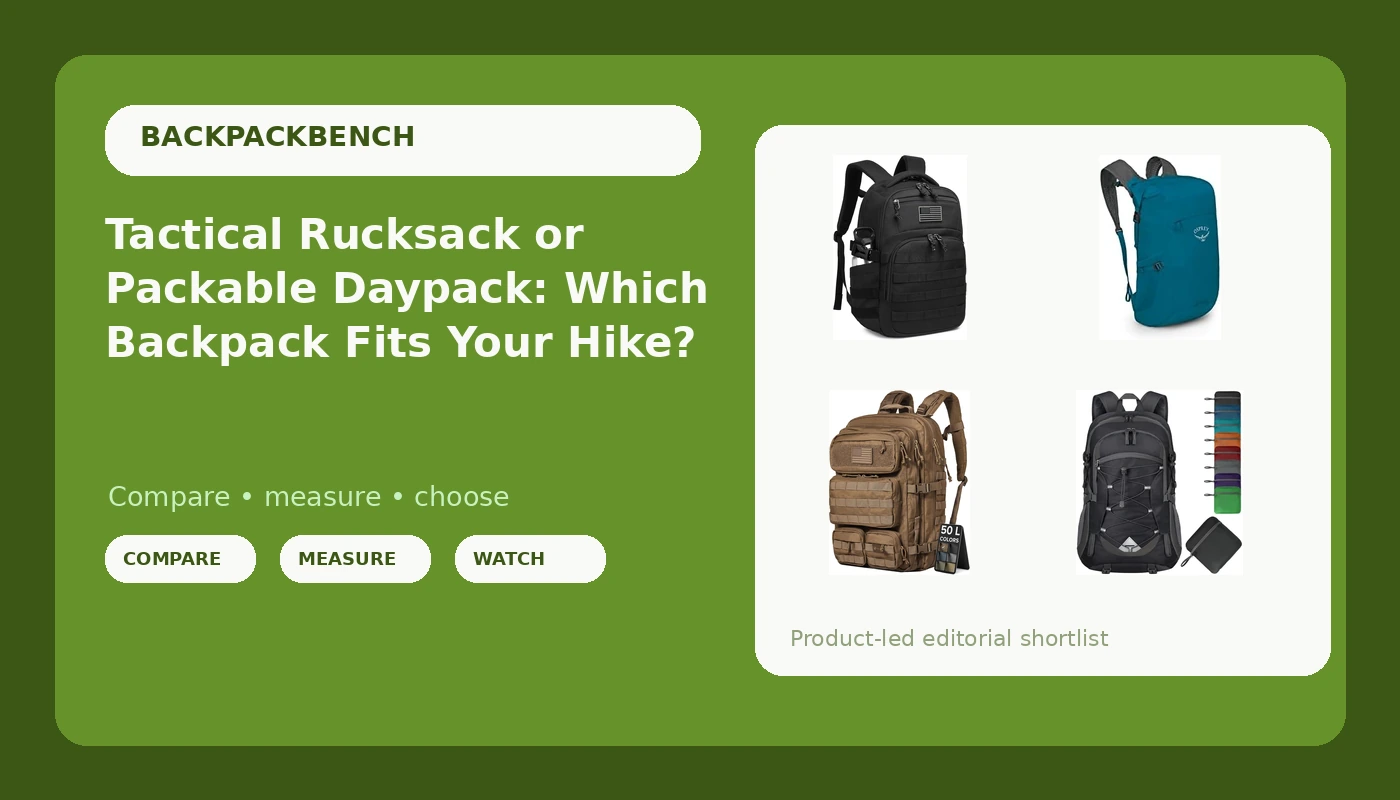
Four packs, four different jobs, and one question I get almost every week at the shop: is a packable hiking backpack enough, or do you need a framed rucksack? On a search results page the listings look interchangeable. A 40L packable daypack, a small military-style bag, a 50L MOLLE rucksack, and an ultralight 20L dry stuff pack all have straps, zippers, and a lid or a roll top. What separates them is volume, how the load transfers to your hips, and whether the structure matches the weight you actually plan to carry. Get that match wrong and the pack becomes the reason the hike ends early.
Related: How to Measure Your Torso Length Before Buying a Backpack →
Quick answer
Match the pack to the load, not to the trip's reputation. Above roughly 20 pounds of total weight, you want a structured pack with a load-bearing hip belt. Under about 15 pounds, a frameless packable daypack is comfortable and packs down small. The Wotony small tactical bag and the Falko 50L rucksack are the structured, gear-heavy options in this group. The IGOLUMON 40L is the lightweight packable option. The Osprey Ultralight 20L Dry Stuff Pack is a dry stuff pack: it keeps gear dry inside a larger pack or works as a minimal 20L bag, and it is not a load-hauling pack.
Four useful options
| Model | Best fit | What stands out |
|---|---|---|
| Wotony Military tactical backpack, backpack for men black small tactical assault bag | Day trips and short carries with a compact structured pack | Small assault-bag profile in black with a military-style layout |
| Osprey Ultralight 20L Dry Stuff Pack, Blue OS | Keeping gear dry and adding a light 20L option | 20 liters, one size, blue dry stuff pack design |
| Falko Tactical Backpack for Men and Women 50L Backpack 2.4x Stronger Large Military Molle Rucksack, Bugout Backpack Outdoors | Multi-day or gear-heavy carry | 50L volume, MOLLE rucksack layout, listing describes 2.4x stronger construction |
| IGOLUMON Hiking Backpack 40L Packable Lightweight Camping Daypack Men Women | Travel and day hikes where packed size matters | 40L packable lightweight daypack design |
The compact structured pack: Wotony Military tactical backpack, backpack for men black small tactical assault bag
Where this pack earns its place is organization in a small footprint. A tactical layout usually means exterior attachment points and compartmentalized pockets, which is exactly what you want when the load is a jacket, water, tools, and a first aid kit. Where it loses is volume. If your gear list runs to a sleeping bag, a shelter, and three days of food, a small bag will not cover it, and lashing the overflow to the outside moves weight away from your spine, which is the opposite of what load transfer wants.
The dry stuff pack: Osprey Ultralight 20L Dry Stuff Pack, Blue OS
The value of a dry stuff pack is narrow and real. It keeps a sleeping bag, spare layers, or a down quilt dry inside a larger pack, and it doubles as a light 20L bag for a summit day or a town stop. It is not competing with a framed 50L rucksack on load carry, and you should not expect it to. Buy it as an addition to a main pack, not as the pack you carry for a week.
The large rucksack: Falko Tactical Backpack for Men and Women 50L Backpack 2.4x Stronger Large Military Molle Rucksack, Bugout Backpack Outdoors
Fifty liters is the volume where a pack stops being a daypack and starts needing a real suspension conversation. The MOLLE layout gives you external real estate for strapping on gear, which helps when your kit does not fit inside. The trade-off is that a large tactical rucksack typically carries load with a padded waist belt rather than a molded suspension system, so where that belt lands on your hips matters more than any feature on the list. A belt that rides up onto your waist puts the weight back on your shoulders, and that is a long day.
The packable daypack: IGOLUMON Hiking Backpack 40L Packable Lightweight Camping Daypack Men Women
The appeal here is packed size, not load capacity. A packable daypack folds into its own pocket and disappears into a larger bag or a suitcase, which makes it the right answer for a travel trip with day hikes attached, or as a backup bag on a trip where the main pack stays at camp. The trade-off runs in the other direction: lightweight fabric and minimal structure mean the comfortable load ceiling is low. Forty liters of volume does not mean forty liters of comfortable weight, and that distinction is the whole reason this category exists.
Prices and availability may change. Product images, names, and retailer links are matched to verified listings. No current price, rating, stock status, or measured result is stated here without current evidence.
Fit first: torso length and hip belt transfer
Torso length is the measurement from the seventh cervical vertebra, the bony bump at the base of your neck, down to your iliac crest, the top of your hip bones. It is not your height and it is not your shirt size. Two people who are both five foot eight can need different pack sizes, and a pack that is one size off will not transfer load no matter how many features it has.
The hip belt does most of the work. On a properly fitted pack, roughly 80 percent of the weight should sit on your hips, with the shoulder straps stabilizing the load rather than carrying it. That only happens when the belt wraps the iliac crest and can be cinched tight without sliding upward. If your belt climbs toward your waist as you walk, the pack is either the wrong torso length or the belt is not stiff enough for the load.
Shoulder straps and load lifter straps are fine tuning on top of that. The straps should curve over your shoulders without gaps, and the load lifters should angle up and forward from the shoulder anchor to pull the top of the pack toward your body. If you have to crank the shoulder straps to keep the pack from sagging, the problem is the hip belt, not the straps.
This is why the same pack can feel great on one hiker and miserable on another. Fit is the variable, and it is the one spec sheet you cannot read off a listing.
Volume, packed size, and the weight on your back
Liters measure space, not comfort. A 50L rucksack and a 40L packable daypack are not interchangeable just because both numbers sound large. What matters is how much weight the structure can move to your hips and how the pack behaves once it is full.
Base weight is everything in your pack except food, water, and fuel. A typical weekend setup with a tent, a bag, a pad, a stove, and layers lands somewhere in the 15 to 25 pound range before consumables. Add two liters of water and a day of food and you are well past the point where a frameless bag stops being pleasant.
That gives you a rough rule. Under about 15 pounds total, a frameless or minimal pack is fine. From 15 to 20 pounds, it depends on how the pack carries and how far you are going. Above 20 pounds, you want a frame and a load-bearing hip belt, and you want the belt to sit on your hips. Volume ratings tell you whether your gear fits. They tell you nothing about whether you can carry it for ten miles.
How to choose, step by step
- Measure your torso length with a tape and a friend before you look at any listing. Everything else is downstream of this number.
- Estimate your total load: base weight plus water plus food. Write the number down instead of guessing.
- Decide whether you need a frame. Above 20 pounds, yes. Under 15 pounds, a packable daypack is comfortable and travels smaller.
- Check hip belt placement. It should sit on your iliac crest and stay there when you tighten it, not ride up onto your waist.
- Confirm volume against your actual gear, then compare features. If the volume is wrong, the features do not matter.
Practical guidance before you buy
- Bring your real gear to the fitting, not a list of it. Volume estimates go wrong when you guess.
- Weigh your loaded pack. The tag weight is not the number that decides whether mile eight hurts.
- Test reach while wearing the pack. A pocket you cannot open without stopping is worse than no pocket.
- If the pack is a travel backup, check how small it packs down, because that is the entire reason to own it.
- Treat strength and capacity claims on the listing as claims. They are starting points for a decision, not verdicts.
- If the pack is meant to protect gear from weather, decide whether you want a dry bag, a rain cover, or both.
Which option should you choose?
Choose the Wotony Military tactical backpack when you want a small, structured, military-style day pack for short carries and organized pocket access. Choose the Osprey Ultralight 20L Dry Stuff Pack when your goal is keeping a sleeping bag or spare layers dry inside a larger pack, or adding a light 20L bag for summit days. Choose the Falko Tactical Backpack for Men and Women 50L Backpack when you need multi-day volume and a MOLLE layout for external gear. Choose the IGOLUMON Hiking Backpack 40L Packable Lightweight Camping Daypack when packed size and light weight matter more than load capacity.
Volume ratings, weight claims, and construction descriptions here come from the product listings, not from a loaded trail test on my part. I have not carried these four specific packs on a measured hike, so treat fit as something you verify with your own torso measurement, your own gear, and your own loaded weight.
The bottom line
The pack decision comes down to two numbers and one fit. Know your total load, know your torso length, and then match the structure to the weight. If you are carrying under 15 pounds and want something that disappears into a suitcase, the packable 40L daypack is the logical pick, with the Osprey dry stuff pack handling weather protection. If you are carrying 20 pounds or more across multiple days, the structured options are the ones worth fitting properly, and the 50L rucksack is the volume choice in this group. Buy the fit first, and let the features follow.