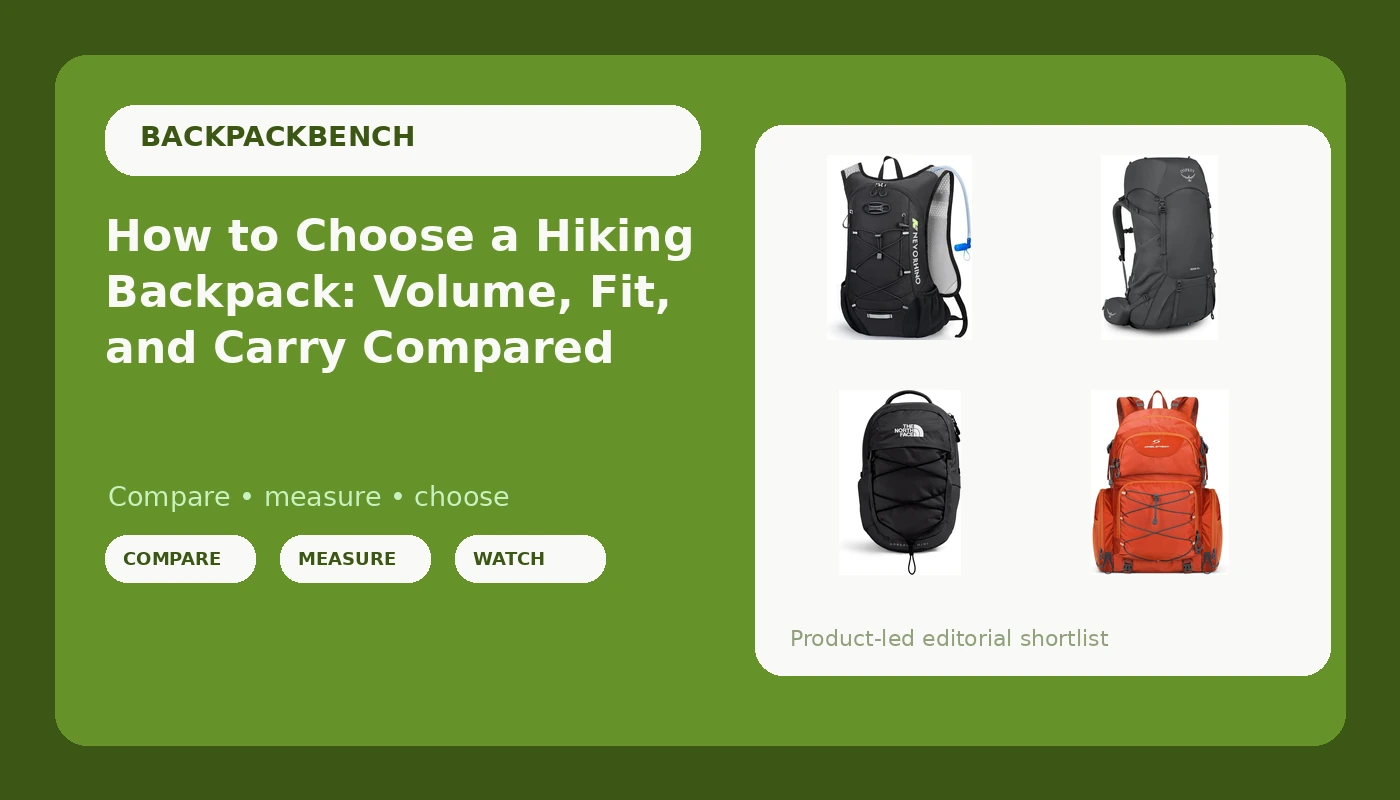
Choosing a hiking backpack is the one gear decision that touches every mile of a trip. Get it right and the load disappears into your hips, the pockets land where your hands already are, and the pack stops being something you think about. Get it wrong and you spend the whole day hitching the hip belt back down, tugging straps, and stopping to dig for a snack you cannot reach. The confusing part is that the spec sheets do not help much. A page can list twenty-five features and still never mention the number that decides everything: torso range. This guide walks through how volume, fit, and carry style separate the four packs below, and how to tell which category your own trips fall into.
Related: How to Measure Your Torso Length for a Backpack →
Quick answer
Measure your torso first, then match volume to the trip. A 65-liter pack like the Osprey Rook is built for multi-day loads with a real frame and hip belt. A 40-liter waterproof pack like the Maelstrom covers wet-weather day hikes and light travel. A compact everyday pack like the Borealis Mini handles commuting and short walks. A hydration running pack with a 2-liter bladder is for moving fast with your hands free. Volume and fit are separate decisions, and fit comes first.
Four useful options
| Model | Best fit | What stands out |
|---|---|---|
| Osprey Rook 65L Men's Backpacking Backpack, Gray OS | Multi-day backpacking trips | 65-liter volume with a men's-specific design from a brand known for suspension |
| Maelstrom 40L Waterproof Hiking Backpack, Lightweight Travel Daypack | Wet-weather day hikes and travel | 40-liter capacity with a waterproof construction and lightweight build |
| The North Face Borealis Mini Backpack, TNF Black/TNF Black-NPF, One Size | Commuting and short day walks | Compact everyday size in a single one-size configuration |
| Lightweight Hydration Backpack, Running Backpack with 2L Water Bladder | Running and fast-and-light days | Integrated 2-liter water bladder for hands-free hydration |
The multi-day hauler: Osprey Rook 65L Men's Backpacking Backpack, Gray OS
Sixty-five liters is the volume where people stop arguing about grams and start arguing about how the load sits. At that size you are probably carrying a shelter, a sleep system, food, and water, and the total can climb fast. The pack's job is to move that weight onto the shelf of your hips instead of hanging it from your shoulders. That transfer is the whole game. If a 65-liter pack puts the load on your shoulders, no amount of padding or pocket design saves the day. The trade-off is honest: a pack in this class is more than a day hiker needs, and it will feel oversized on a two-hour walk. Buy it for the overnight trips you take, not the ones you imagine.
The weatherproof daypack: Maelstrom 40L Waterproof Hiking Backpack, Lightweight Travel Daypack
Forty liters is a strange, useful size. It is more than most people need for a day hike and less than most people need for a weekend, which makes it the pack that quietly covers the widest range of real trips: a long ridge walk with a puffy and a stove, a rainy commute with a laptop, a carry-on for a short flight. Waterproof construction matters more than the marketing suggests, because rain covers have a known failure mode. They fit the pack and not the load, so a stuffed pack bulges out from under the cover and the water finds the seam. A pack whose body is already water-resistant sidesteps that problem. The trade-off is that waterproof fabrics and closures can be fussier to pack and slower to get into than a plain nylon lid, so weigh how often you actually hike in rain.
The everyday city pack: The North Face Borealis Mini Backpack, TNF Black/TNF Black-NPF, One Size
Not every backpack needs to be a trail pack, and pretending otherwise is how people end up hauling an empty 65-liter bag onto a bus. A mini pack earns its place by being the one you actually pick up on a Tuesday. The catch is that "one size" means exactly that: there is no torso adjustment and no hip belt doing load transfer, so the fit question becomes about strap length and back panel length rather than a size chart. For a light load that is fine. For a heavy load it is not, and no amount of pocket organization fixes it. Treat this as a daily carry pack and it will do its job well.
The running and fast-and-light option: Lightweight Hydration Backpack, Running Backpack with 2L Water Bladder
Hydration packs solve a specific problem: drinking without breaking stride. The 2-liter bladder in this one covers a couple of hours of hard effort, and the tube means you sip while you move instead of stopping to unscrew a bottle. The design philosophy is the opposite of a backpacking pack. There is no frame and no load-transferring hip belt, because there is no heavy load to transfer. Everything is about stability at speed and access while moving. That makes it a poor choice for carrying a shelter and a stove, and an excellent one for a trail run or a fast solo day where the only real cargo is water, a layer, and a snack.
Prices and availability may change. Product images, names, and retailer links are matched to verified listings. No current price, rating, stock status, or measured result is stated here without current evidence.
Why torso length decides whether a pack works
Torso length is the distance from the bony bump at the base of your neck, the C7 vertebra, down to the top of your hip bones at the iliac crest. It is not your height, and it is not your shirt size. Two people who are both five foot ten can differ by three or four inches in torso length, which is why one of them loves a pack the other one cannot stand. The measurement matters because the hip belt has to land on the iliac crest to carry weight. If the torso is too long for the pack, the belt rides up onto your waist, where it can only squeeze instead of support. If the torso is too short, the belt sits below the hips and the load swings. Every other feature on the pack is downstream of getting this one number right.
Volume, load, and how the weight actually moves
Volume tells you what fits. It says nothing about how the pack carries, and those are different problems. A useful way to think about it is by trip length and consumables. A day hike needs room for water, food, a layer, and a small emergency kit, which is roughly the 20 to 40 liter range. An overnight adds a shelter, a sleep system, and a stove, which pushes most people into the 50 to 65 liter range. Beyond that you are carrying for multiple nights or carrying for someone else. Once the load passes roughly 20 pounds, the hip belt should be carrying most of it, and the shoulder straps should mostly be holding the pack against your back rather than holding it up.
- Measure your torso from C7 to the top of your hip bones, and write the number down before you shop.
- Compare that number against the torso range the manufacturer lists, not against your height or your t-shirt size.
- Estimate your total load weight, including food and water, then pick the volume that covers it with a little room to spare.
- Load the pack at home with the weight you expect to carry and adjust the hip belt first, then the shoulder straps, then the load lifters.
- Walk at least a few miles with that load and check where the pressure is at the end. Shoulders mean the belt is not doing its job.
Matching a pack to the trip you actually take
- Count your real trips from the last year, not the trips you plan to take someday. The pack should fit the former.
- If most of your days are under four hours, a 40-liter class pack or smaller will serve you better than a 65-liter hauler.
- If you hike in sustained rain, prioritize a pack body that resists water over a separate rain cover that fits the pack but not the load.
- If you run or move fast, a vest-style hydration pack with an integrated bladder beats a daypack plus bottles every time.
- Try any pack on with weight in it before you commit, because a pack that fits well on the shop floor can behave differently at mile eight with a full load.
Which option should you choose?
Choose the Osprey Rook 65L Men's Backpacking Backpack, Gray OS when your trips involve at least one night out and you need a framed pack to carry a full kit. Choose the Maelstrom 40L Waterproof Hiking Backpack, Lightweight Travel Daypack when your days are long, the forecast is wet, or you want one pack that doubles as a travel bag. Choose the The North Face Borealis Mini Backpack, TNF Black/TNF Black-NPF, One Size when the pack is for commuting, classes, and short walks rather than trail loads. Choose the Lightweight Hydration Backpack, Running Backpack with 2L Water Bladder when you are running or moving fast and want water on your back instead of in your hands.
Two caveats are worth stating plainly. First, none of these recommendations replace a torso measurement, and a pack that does not match your torso length will underperform no matter how good the listing looks. Second, the specific fit, comfort, and durability of any individual pack depends on your body, your load, and the trail, so treat the product pages as the source of current specifications and dimensions rather than this overview.
The bottom line
Choosing a hiking backpack is a sequence, not a shopping spree. Measure your torso, decide the volume your real trips require, and only then compare models. The Osprey Rook 65L covers multi-day loads, the Maelstrom 40L covers wet day hikes and travel, the Borealis Mini covers daily carry, and the hydration running pack covers fast, light efforts with a 2-liter bladder on your back. Fit comes first, volume comes second, and features come a distant third.